
English for Children & Teens
A comprehensive English programme from beginner to intermediate for ages 6–17. The children's programme (ages 6–12) uses games, tasks and activities to build spontaneous communication. The teens programme (ages 13–17) prepares students for Cambridge examinations.
The programme is divided into four age-appropriate levels:
- Bubbles — ages 6–8
- Junior — ages 8–10
- Go World — ages 11–13
- Teens — ages 13–17
Teens who complete all four levels are ready to sit the Cambridge First Certificate in English (FCE). Teaching methods include games, debates, discussions and listening exercises. Teachers encourage students to speak in English throughout every lesson.
Who this course is for
The programme is built for children and teenagers aged 6–17, and groups are formed by age as well as by level — an eight-year-old does not sit in the same class as a fifteen-year-old.
- Children starting English for the first time — we begin at A1, no prior knowledge needed.
- Children who have English at school but do not speak it — here the lesson is built on speech rather than written grammar.
- Teenagers who need a Cambridge certificate — a student who finishes the four levels is ready to sit B2 First (FCE).
- Families planning to study abroad — an early start makes later exam preparation considerably easier.
If your child is under 6, look at the DOTS First English programme, which is built for ages 1–6. An age guide: when to start English with your child (ages 3–17).
Four levels: from age 6 to FCE
- Bubbles (6–8) — first words and simple phrases through games, songs and movement; very little writing.
- Junior (8–10) — reading and writing are added, short dialogues on everyday topics.
- Go World (11–13) — longer texts, project work and short presentations.
- Teens (13–17) — debates, discussions, academic text; an introduction to the Cambridge exam format.
Teenagers who complete all four levels are ready to sit the Cambridge First Certificate in English (FCE). For separate targeted preparation there is the Exam Preparation course. On CEFR levels: A1 to C2 explained.
What a lesson looks like
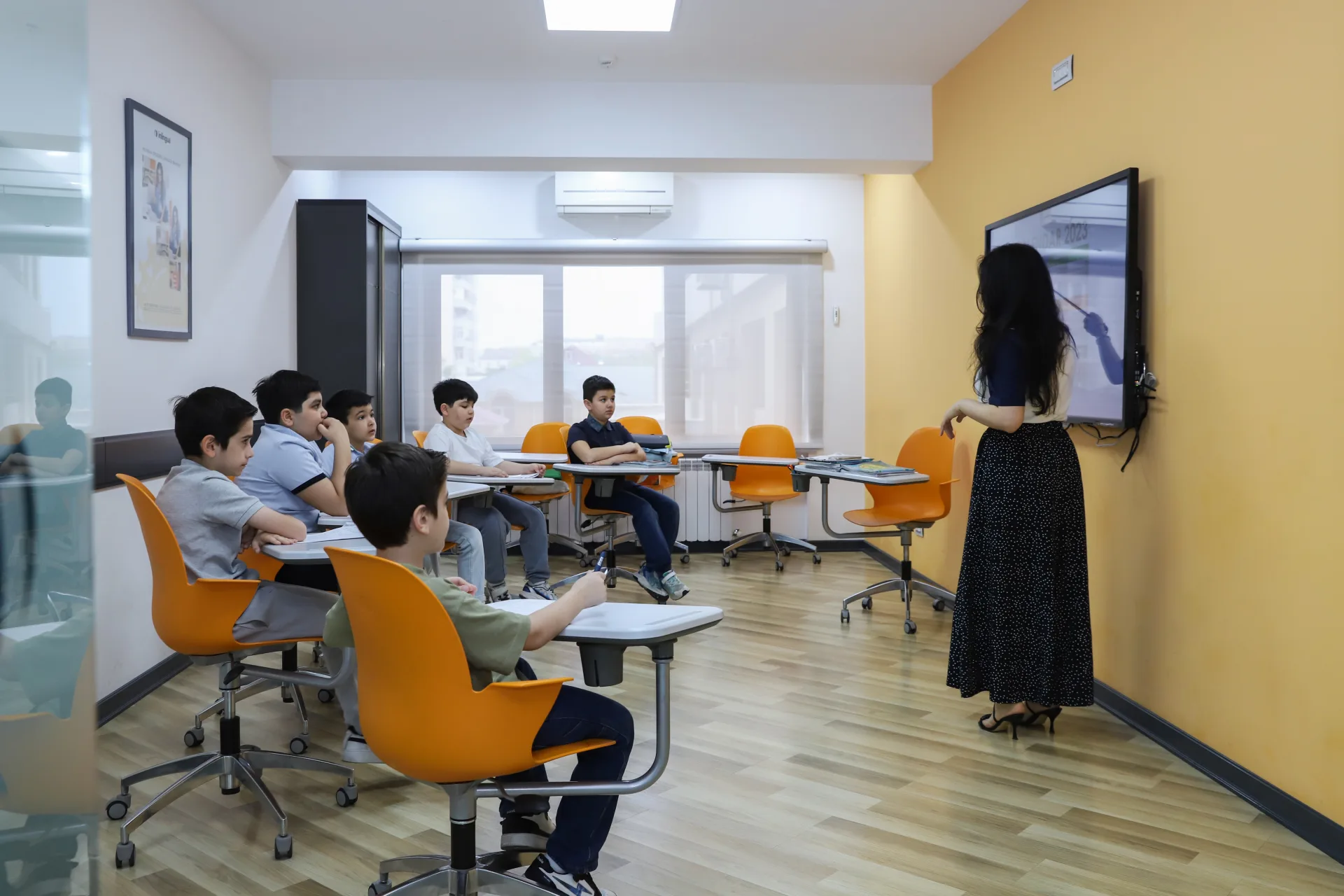
Lessons run on the Inlingua method, in English from the first minute, with no translation. For a child this is the most natural route: hear it, repeat it, and only then understand the rule.
- Younger groups get games, movement tasks and songs, in short blocks matched to their attention span.
- Teenagers get debates, discussions and listening tasks — a format different from school.
- The teacher draws every student into speaking English in every lesson; sitting quietly is not an option.
- Progress is monitored continuously, with an assessment at the end of each level.
- Rote memorisation and translation exercises are not used.
The materials you work with
Textbooks are designed in Bern and published in Switzerland by the Inlingua Bern publishing house exclusively for schools in the association, with a separate series for each age group.
- textbooks matched to age and level;
- tests and assessment materials, so parents can see progress;
- audio and video resources;
- access to the online learning platform.
More detail: Teaching materials.
Format, schedule and price
Classes fit around the school timetable — group, mini-group or one-to-one, at the centre or online. Materials and teachers are the same in both formats.
Before enrolment there is a free placement test: a short conversation with your child, after which we place them in a group by age and level. No obligation. The price depends on the age group, the format and the intensity — message us on WhatsApp and we will send the full price list.
Which group fits your child? Send us their age — we will arrange the free placement test and pick a schedule together.
Chat on WhatsAppFAQ
My child has no English at all — will you take them?
Yes. Every age group starts at A1 and no prior knowledge is required. During the free placement test we have a short conversation with your child and place them in a group by age and level.
How are the groups formed?
By age and by level. There are four age steps: Bubbles 6–8, Junior 8–10, Go World 11–13, Teens 13–17. This keeps task difficulty and topics appropriate to the child.
Will the classes clash with the school timetable?
The schedule is built around school hours, and an online format is available. We pick a workable time together before enrolment.
If the lesson is entirely in English, will my child understand?
Yes. The teacher grades their language to the level and leans on pictures, gestures and play. This is exactly the order in which a child acquires a language — hearing first, understanding after.
Will my child be able to sit a Cambridge exam later?
Yes. Teenagers who complete all four levels are ready to sit the Cambridge First Certificate in English (FCE). If a specific exam date is the goal, there is a separate Exam Preparation course.
How much does the course cost?
The price depends on the age group, the format (group or individual) and the intensity. Message us on WhatsApp and we will send the full price list straight away. The placement test is free.
Next step: tell us your child's age and we will suggest the right group and schedule. Contact page.