
When to Start English with Your Child: A 3–17 Age Guide
When should your child start English — age 3, 6, or 10? What the research says, an age-by-age reality check, and which Baku courses fit which age. A full age guide from Inlingua Baku teachers.
When should your child start English — at 3, 6, or 10? Short answer: the earlier the better — with caveats. Research points to a "critical window" (ages 3–8) when language is especially easy to absorb. But starting at 3 doesn't mean fluency at 5; the wrong format at any age is counterproductive. Inlingua Baku teachers give you the realistic age-by-age guide.
What the science says: the "critical period"
Linguist Eric Lenneberg proposed in 1967 that the human brain has a window of heightened sensitivity to language — roughly ages 3–12. Later research showed the window doesn't slam shut; it narrows gradually:
- Ages 3–6: pronunciation and phonology absorb perfectly — the child will grow up "accent-free".
- Ages 6–10: grammar and vocabulary build rapidly.
- Ages 10–14: still excellent outcomes, but a slight accent tends to remain.
- Ages 14–17: more analytical learning; accent more noticeable.
- 18+: possible, but adults need disciplined consistency to match native proficiency.
Important nuance: this biological bias is a gradient, not a closed door. Someone starting at 25 can still reach C2 — it simply takes more time and deliberate work.
Ages 3–6: the ideal window (but wrong format backfires)
At this age, children learn language as experience, not as rules. The formats that work:
- Songs, rhymes, stories — the child absorbs the music of the language.
- Games and everyday scenarios — "at the shop", "on the plane", "at the zoo".
- Picture books — Peppa Pig, Ben and Holly, ABC books.
- Cartoons — 10–15 minutes a day in English.
What backfires: forcing the alphabet, teaching grammar, giving tests. Stress at this age pushes children away from the language.
Inlingua's DOTS First English program starts at age 1 on exactly this principle — natural absorption through play and repetition.
Ages 6–10: the best time for a structured start
The child can read and write, and their brain is ready for rules — but play remains central. For this age:
- 2 lessons/week, 45–60 minutes each.
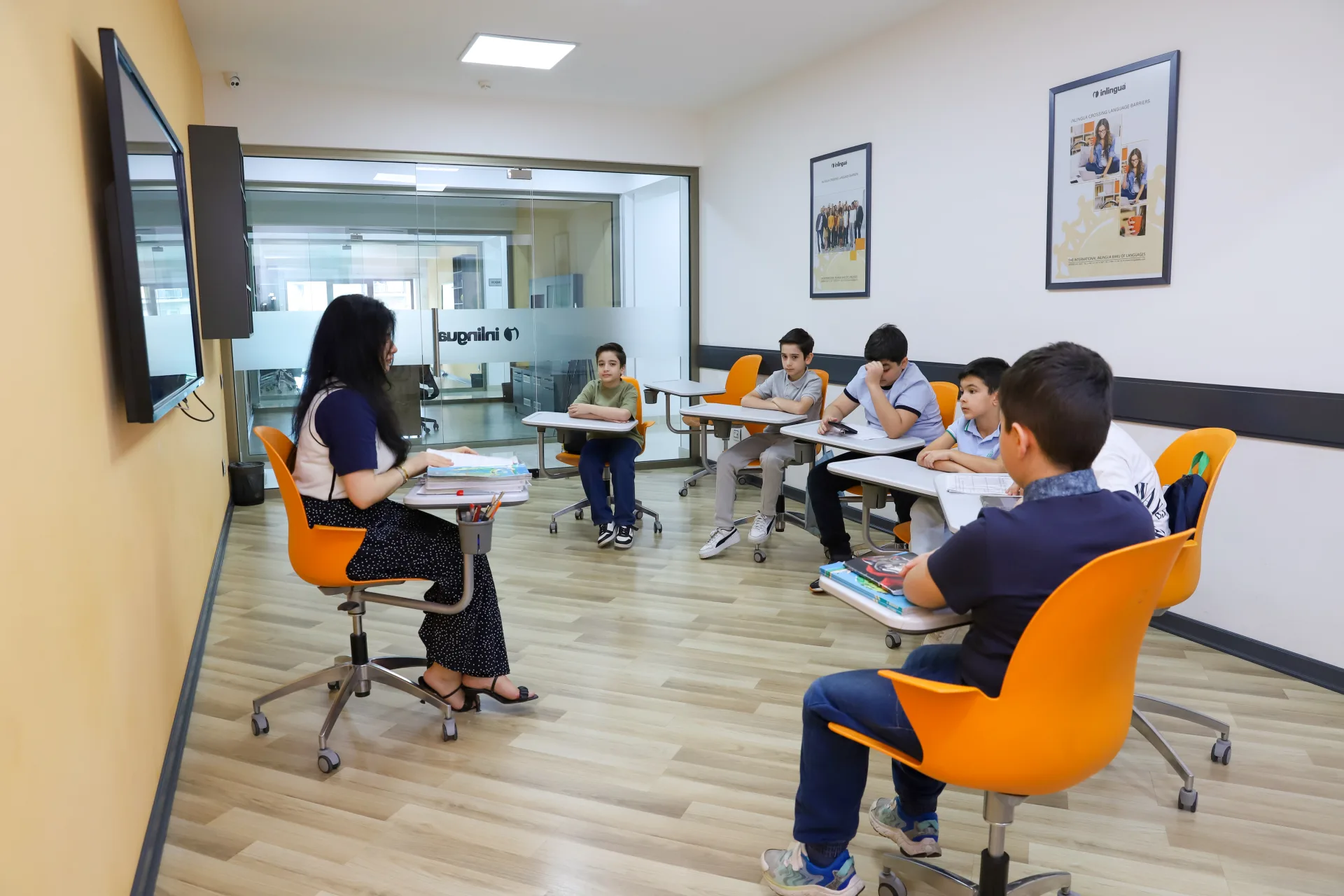
- Small groups (6–8 kids) — individual attention plus social dynamics.
- Light homework, no heavy workload — 10–15 min/day.
- Cartoons + YouTube — Super Simple Songs, Blippi, Diana and Roma.
2–3 years of this kind of structured learning reliably reaches B1 by age 10.
Ages 11–14: window still open, motivation harder
Language-learning capacity remains high, but two new obstacles appear:
- School load — maths, physics, exams.
- Social dynamics — teens fear making mistakes in front of peers.
The strategy has to shift — specific goals matter: "Cambridge FCE", "IELTS 6.0", "admission to a foreign university". The teen needs to see the goal.
Inlingua's English for Children & Teens course is designed for 6–17, with four level-appropriate tiers.
A course-by-age table for both languages: English and Russian courses for kids.
Ages 15–17: exam prep and the final sprint
At this stage, the learner is no longer a "kid course" student — they can move into adult courses. But the goal has to be concrete:
- International university admission — IELTS, TOEFL.
- School certification — FCE, CAE.
- Simply fluency and confidence.
At this age, 3–6 months of focused prep can produce disproportionate results — the teenager can reason strategically.
Common parent questions
My child doesn't fully speak Azerbaijani yet — is English harmful?
No — the opposite. Bilingual children show stronger cognitive development. The child may initially mix languages, but they separate them by age 6–7. "Mixing" is a phase, not a problem.
Do we absolutely need a native-speaker teacher?
For children, no. Below age 6, the teacher's knowledge of child psychology matters far more. A bad native speaker won't beat a well-certified Azerbaijani teacher.
How much English YouTube is harmful?
Under 3, keep screen time minimal. Ages 3–6, cap at 30 min/day. 6+, don't cap strictly but watch the content — pick interactive material, not passive viewing.
My child doesn't want English — should I force it?
Don't force. Change the format (group → private or the reverse), change the teacher, change the content. The child rejects the experience, not the language — with the right experience, love for the language follows.
Aren't the English lessons at school enough?
Most school lessons are in 30+ student classrooms with no speaking practice. School gives a foundation of comprehension, but real fluency needs a course or consistent practice.
When is too early?
Programs start from age 1 — Inlingua's DOTS First English is for ages 1+. But this is not "class"; it's a play-exposure environment. Starting this early isn't mandatory, but it isn't harmful either.
My child attends classes but I can't see grades — what do I do?
In the first 3 months children develop language "passively" — they understand but don't speak. This is the "silent period" and it's normal. Speaking should start around month 6. No progress after 9 months signals you need to change teacher or format.