
General Russian
Our Russian courses are focused on developing practical, everyday communication skills. From the first lesson, students begin speaking — no rote learning, no translation. Discussions, debates, games and speaking tasks form the core of every class.
Our modern, well-equipped centre creates a Russian-language immersion environment. Our goal is to help students absorb the language in the shortest possible time.
- Communicative teaching method from day one
- Modern classroom with audio-visual resources
- Qualified, experienced Russian language teachers
- All levels A1–C2, group and individual options
Who this course is for
General Russian is for adults and teenagers who need Russian in daily life and at work in Baku. You can start from zero, with the Cyrillic alphabet.
- For work — in logistics, construction, trade and tourism, Russian gives a clear edge in the Azerbaijani job market.
- Parents of children in Russian-medium schools — so you can help with homework. For the child there is the Russian Homework Help programme.
- People working across the region — in Central Asia and the Caucasus, Russian is still the practical language of business.
- People rebuilding lost speech — you heard it as a child, but now the sentence will not come together.
If your goal is an exam, see the Russian Exam Preparation course; for children there is the Children and Teens programme.
From A1 to C2: your level path
The first two obstacles are the same for everyone, and both are passable:
- The Cyrillic alphabet — 33 letters. At 15 minutes a day you can read text by the end of the first week and start writing in about two.
- Cases — six of them, changing the form of every noun and adjective. This is the main work of the first three months, and they settle through practising each case separately rather than memorising a table.
After that comes the standard CEFR path: A1 introductions and simple phrases, A2 everyday situations, B1 fluent speech and business correspondence, B2 complex texts and working Russian, C1 academic and journalistic language, C2 near-native command. A table with indicative timings per level: how to learn Russian — the guide.
What a lesson looks like
Lessons run on the Inlingua method, in Russian from the first minute, with no translation. For a grammar-heavy language this works particularly well: the rule settles in practice first and is systematised afterwards.
- Discussions, debates, games and speaking tasks form the backbone of every lesson.
- The teacher works as a coach — most of the talking time belongs to the student.
- A modern classroom equipped with audio and video resources.
- Progress and speech accuracy are monitored continuously, with an assessment at the end of each level.
- Baku's Russian-speaking environment is a ready-made daily practice ground — what you cover in class you can use the same day.
The materials you work with
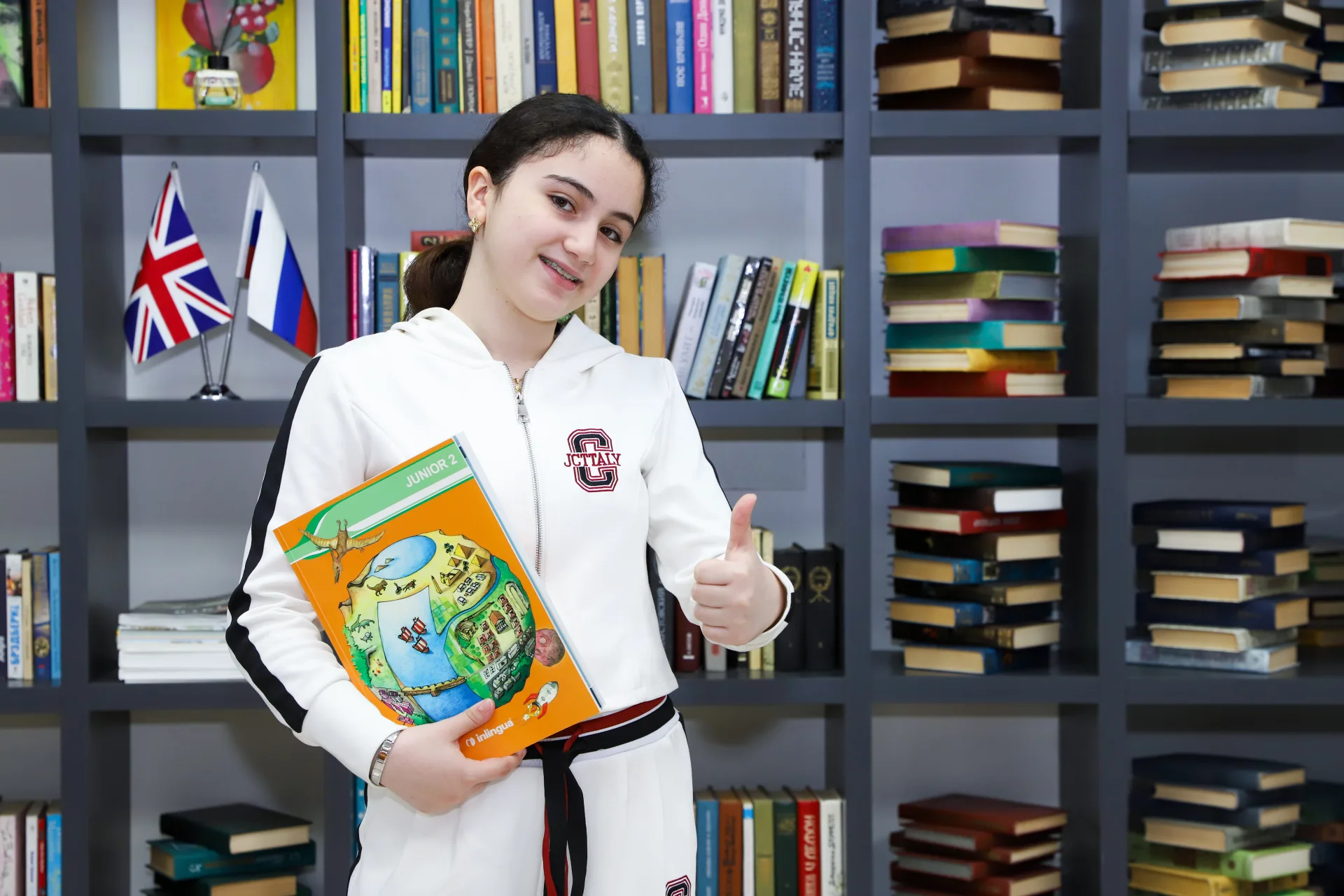
Textbooks are designed in Bern and published in Switzerland by the Inlingua Bern publishing house exclusively for schools in the association.
- textbooks organised by level — topic-based texts, grammar, listening and speaking tasks;
- tests and assessment materials;
- audio and video resources;
- access to the online learning platform.
There are also free PDFs on the site: a Cyrillic pronunciation guide, a short guide to the cases and the 100 most frequent words — the Russian language guide. On materials: Teaching materials.
Format, schedule and price
The course runs as a group, a mini-group or one-to-one, at the centre or online — the materials and the teachers are the same.
Before you start there is a free placement test: a short conversation on WhatsApp or at our office, where we establish your CEFR level and recommend a group. No obligation. The price depends on level, format and intensity — message us and we will send the full price list.
Starting from zero, or rebuilding lost speech? The free placement test on WhatsApp takes 10 minutes — we tell you your level and recommend a group.
Chat on WhatsAppFAQ
I cannot read Cyrillic — can I still start the course?
Yes. The course starts from zero and the first lessons are devoted to the alphabet. With 15 minutes of practice a day you can read text by the end of the first week; writing takes about two weeks.
Are Russian cases really that hard?
Cases are the most time-consuming part of Russian: six of them, changing the form of every noun and adjective. In practice they are the main work of the first three months, and they settle through using each case in live speech rather than memorising a table.
Are the lessons entirely in Russian?
Yes. In the Inlingua method the lesson runs in the target language from the first minute and translation is not used. The teacher grades their language to your level, so a beginner group stays comprehensible.
Can I learn Russian on my own?
Up to A2 you can genuinely get there alone — the alphabet, first vocabulary, simple sentences. From B1 the case system is hard going without a teacher. There is a home study plan in our blog: the guide to learning Russian at home.
Is there a programme for my child?
Yes. There is a separate course for ages 3–6, the Children and Teens programme for ages 6–17, and Russian Homework Help for pupils in Russian-medium schools.
How much does the course cost?
The price depends on the level, the format (group or individual) and the intensity. Message us on WhatsApp and we will send the full price list straight away. The placement test is free.
Next step: message us on WhatsApp for the free placement test, or visit the contact page.