
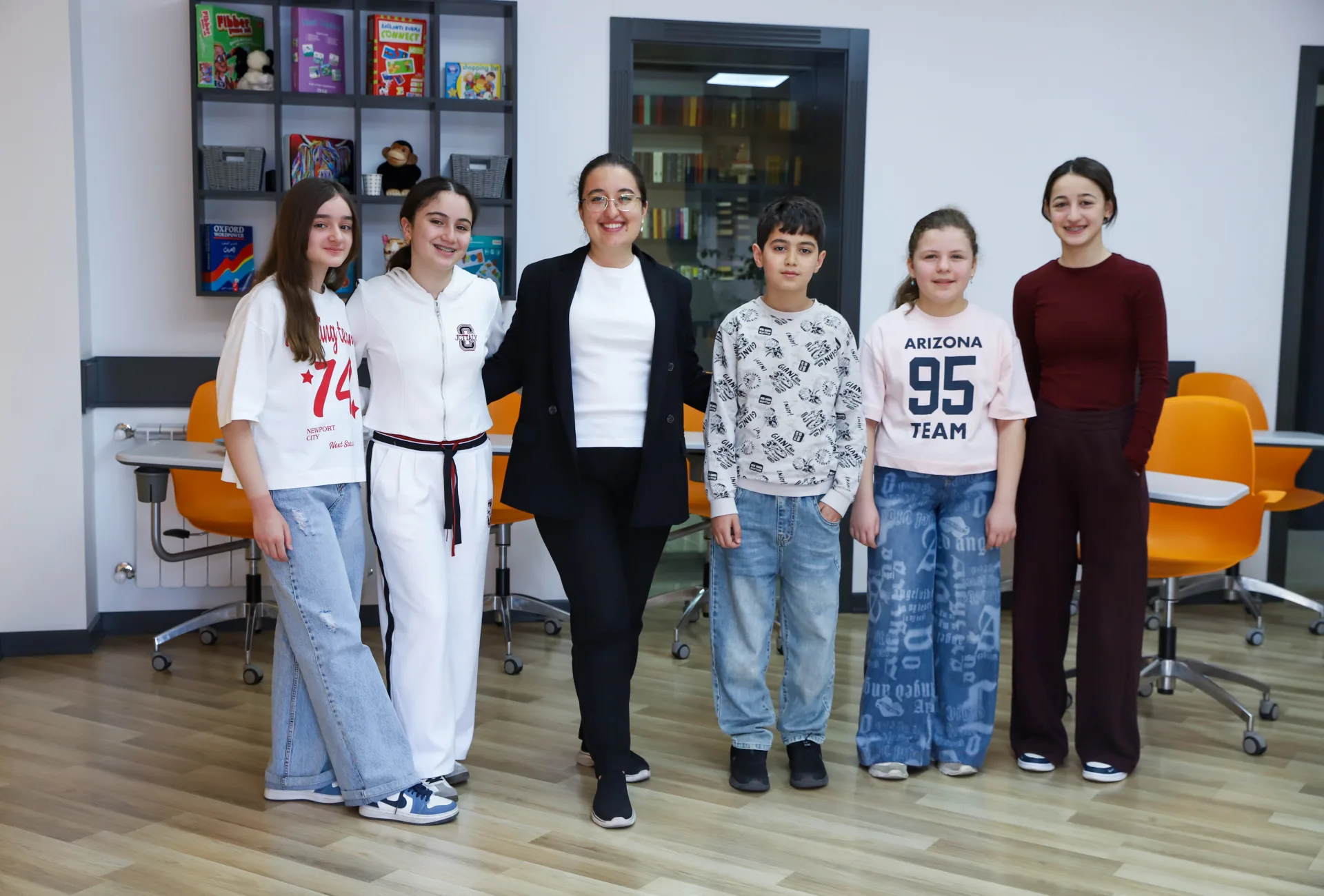
Russian for Children & Teens
A broad Russian course from beginner to advanced for ages 6–17. The children's programme (ages 6–10) builds spontaneous communication skills. The teens programme (ages 11–17) develops all four skills through games, discussions and debates.
Listening and speaking are the core focus throughout all levels. Students are encouraged to use Russian actively in every lesson.
- Children's programme: ages 6–10 (beginner to intermediate)
- Teens programme: ages 11–17 (beginner to advanced)
- Games, discussions, debates and role-play
- Reading and writing developed alongside speaking and listening
Who this course is for
The programme is for children and teenagers aged 6 to 17, and groups are formed by both age and level — an eight-year-old does not sit in the same class as a fifteen-year-old.
- Complete beginners in Russian — we start at A1 and no prior knowledge is required.
- Children who hear Russian at home but will not answer — here the lesson is built on speaking.
- Pupils in Russian-medium schools — a language base running alongside the school syllabus. For the homework itself there is the separate Russian Homework Help programme.
- Teenagers with an exam goal — from B1 they can move on to Russian Exam Preparation.
If your child is under 6, see the Russian for Ages 3–6 programme. All our Russian programmes: Russian language courses in Baku.
Two age programmes: from A1 to C1
- Children's programme (ages 6–10) — beginner to intermediate. The focus is on spontaneous communication: games, role play, short dialogues. Reading and writing develop alongside speaking and listening.
- Teens programme (ages 11–17) — beginner to advanced. All four skills are built through discussions, debates and work with texts.
In both programmes listening and speaking stay the core focus at every level — the student uses Russian actively in every lesson. What the CEFR levels mean: A1 to C2 explained; a table of levels and timings: the Russian language guide.
What a lesson looks like
Lessons run on the Inlingua method, in Russian from the first minute, with no translation. For a grammar-heavy language this works particularly well: the rule settles in practice first and is systematised afterwards.
- Games, discussions, debates and role play form the backbone of every lesson.
- For younger children tasks come in short blocks; for teenagers texts and discussions run longer.
- The teacher draws every student into speech in every lesson — nobody can sit it out.
- Reading and writing develop together with speaking and listening, not as a separate subject.
- Progress is monitored continuously, with an assessment at the end of each level.
The materials you work with
Textbooks are designed in Bern and published in Switzerland by the Inlingua Bern publishing house exclusively for schools in the association; each age group has its own series.
- textbooks matched to age and level;
- tests and assessment materials — parents can see the progress;
- audio and video resources;
- access to the online learning platform.
For practice at home there are free PDFs: a Cyrillic pronunciation guide, a short guide to the cases and the 100 most frequent words — the Russian language guide. On materials: Teaching materials.
Format, schedule and price
The timetable is built around school hours — group, mini-group or one-to-one, at the centre or online. The materials and the teachers are the same in both formats.
Before you enrol there is a free placement test: a short conversation with the child, after which we place them by age and level. No obligation. The price depends on age group, format and intensity — message us on WhatsApp and we will send the full price list.
Which group fits your child? Send us their age and how much Russian they already have — we will book the free placement test.
Chat on WhatsAppFAQ
My child knows no Russian at all — will you take them?
Yes. Both age programmes start at A1 and no prior knowledge is required. At the free placement test we have a short conversation with the child and place them by age and level.
How are groups formed?
By both age and level. There are two age programmes: ages 6–10 and ages 11–17. That split keeps the topics and the difficulty of the tasks appropriate to the child's age.
My child is in a Russian-medium school but struggles with grammar — will this course help?
This course builds the language base: speaking, listening, reading and writing by level. If the school assignments themselves need work, there is a separate homework help programme — most often the two run together. A guide for parents: how to help your child in a Russian-medium school.
The lessons are entirely in Russian — will my child understand?
Yes. The teacher grades their language to the level and leans on pictures, gesture and play. A beginner group stays comprehensible throughout.
Can a teenager prepare for an exam here?
Yes. Once they reach B1 they can move on to the Russian exam preparation course, where the work is on the format of the school-leaving and university entrance exams.
How much does the course cost?
The price depends on age group, format (group or one-to-one) and intensity. Message us on WhatsApp and we will send the full price list straight away. The placement test is free.
Next step: send your child's age on WhatsApp and we will suggest a group and a timetable. Contact page.